
Bangladesh Fertilizer Use Per Hectare 2024: 398.90 kg/ha
Bangladesh's fertilizer use per hectare in 2024 is 398.90 kg/ha, up 2.8% from 2023. It ranks #13 of 189 countries.
Fertilizer use per hectare shows how much fertilizer is applied to agricultural land in different countries, impacting crop yield.
Source (2024): Fertilizer use per hectare
Where Bangladesh ranks (2024)
#13 of 189- #11
 Vietnam420.43 kg/ha
- #12
 Colombia416.02 kg/ha
- #13
 Bangladesh398.9 kg/ha
- #14
 Brazil397.09 kg/ha
- #15
 China393.27 kg/ha
Fertilizer Use Per Hectare over time
| Year | Value | Change | % Change | Actions |
|---|---|---|---|---|
| 2024 | 398.9 kg/ha | +10.88 kg/ha | +2.81% | |
| 2023 | 388.02 kg/ha | +3.11 kg/ha | +0.81% | |
| 2022 | 384.91 kg/ha | 6.68 kg/ha | -1.71% | |
| 2021 | 391.59 kg/ha | +69.1 kg/ha | +21.43% | |
| 2020 | 322.49 kg/ha | +1.92 kg/ha | +0.60% | |
| 2019 | 320.57 kg/ha | +2.07 kg/ha | +0.65% | |
| 2018 | 318.49 kg/ha | +16.44 kg/ha | +5.44% | |
| 2017 | 302.06 kg/ha | +16.54 kg/ha | +5.79% | |
| 2016 | 285.51 kg/ha | 11.75 kg/ha | -3.95% | |
| 2015 | 297.26 kg/ha | +19.29 kg/ha | +6.94% | |
| 2014 | 277.97 kg/ha | +24.8 kg/ha | +9.79% | |
| 2013 | 253.18 kg/ha | 1.04 kg/ha | -0.41% | |
| 2012 | 254.21 kg/ha | +5.35 kg/ha | +2.15% | |
| 2011 | 248.86 kg/ha | +40.84 kg/ha | +19.63% | |
| 2010 | 208.02 kg/ha | +23.73 kg/ha | +12.87% | |
| 2009 | 184.29 kg/ha | 10.73 kg/ha | -5.50% | |
| 2008 | 195.02 kg/ha | +15.42 kg/ha | +8.59% | |
| 2007 | 179.59 kg/ha | 8.87 kg/ha | -4.71% | |
| 2006 | 188.46 kg/ha | 4.43 kg/ha | -2.30% | |
| 2005 | 192.9 kg/ha | +23.4 kg/ha | +13.81% | |
| 2004 | 169.49 kg/ha | +10.4 kg/ha | +6.53% | |
| 2003 | 159.1 kg/ha | 27.99 kg/ha | -14.96% | |
| 2002 | 187.09 kg/ha | +13.97 kg/ha | +8.07% | |
| 2001 | 173.12 kg/ha | — | — |
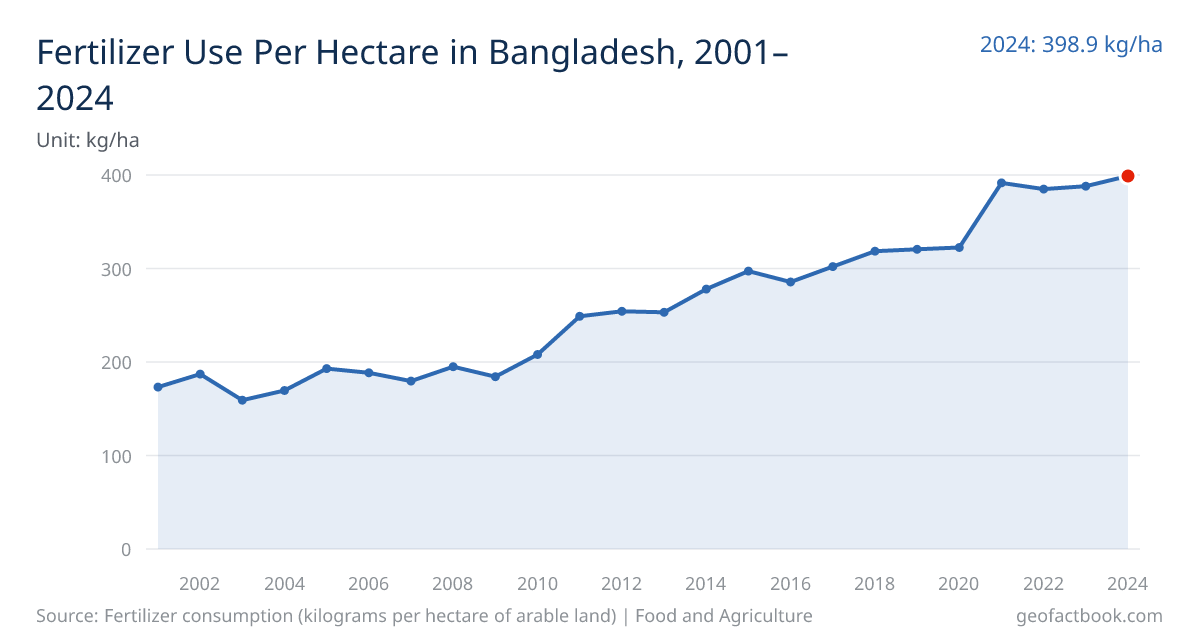
Fertilizer Use Per Hectare in Bangladesh, 2001–2024: chart
Cite this page
Geo Factbook. (n.d.). Bangladesh: Fertilizer Use Per Hectare. Retrieved November 27, 2026, from https://geofactbook.com/countries/bangladesh/fertilizer-use-per-hectare
The figures on this page come from Fertilizer consumption (kilograms per hectare of arable land) | Food and Agriculture Organization of the United Nations (FAO) via World Bank. For academic work, cite the original source as well.
Frequently Asked Questions About Bangladesh Fertilizer Use Per Hectare
What is Bangladesh's fertilizer use per hectare in 2024?▾
Bangladesh's fertilizer use per hectare is 398.90 kg/ha in 2024, according to Fertilizer consumption (kilograms per hectare of arable land) | Food and Agriculture Organization of the United Nations (FAO) via World Bank.
Is Bangladesh's fertilizer use per hectare increasing or decreasing?▾
Bangladesh's fertilizer use per hectare rose by 2.8% from 2023 (388.02 kg/ha) to 2024 (398.90 kg/ha). Over the past decade (2014–2024) it rose by 43.5%.
How does Bangladesh rank for fertilizer use per hectare?▾
In 2024, Bangladesh has the 13th highest fertilizer use per hectare out of 189 countries with data.
What was Bangladesh's fertilizer use per hectare in 2001?▾
In 2001, Bangladesh's fertilizer use per hectare was 173.12 kg/ha. By 2024 it rose by 130.4%.
Explore additional statistical insights
Potato Yield Per Hectare in Bangladesh
Potato yield per hectare assesses agricultural efficiency by measuring how much potatoes are grown per unit area.
Total Renewable Groundwater Resources by Country in Bangladesh
Total renewable groundwater represents the combined volume of internally generated and externally sourced groundwater that is naturally replenished and available for use.
Refined Petroleum Products Imports in Bangladesh
Refined petroleum products imports indicate a country's energy demand. Explore rankings, compare nations, and view interactive maps.
Electricity from Nuclear Fuels in Bangladesh
Electricity from nuclear fuels measures energy production in countries. Compare data, explore rankings, and visualize trends with interactive maps.
Population living in slums in Bangladesh
This statistic measures the percentage of a country's population living in slums, highlighting urban poverty and living conditions. Understanding slum populations is crucial for addressing housing challenges and improving the quality of life.
Threatened Bird Species Count in Bangladesh
Threatened bird species count measures the number of bird species at risk of extinction in each country.