
Victoria Population Growth by Year (2015–2025)
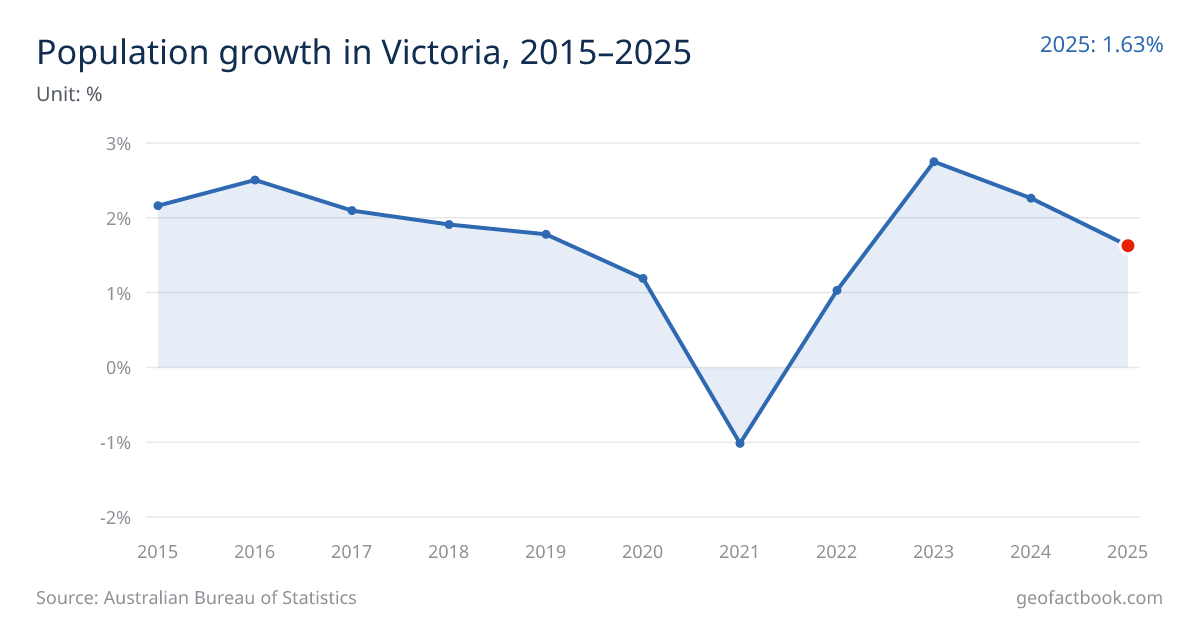
Victoria's population growth was +1.63% in 2025, the 4th highest of any state. Since 2015 (+2.16%) it changed by −0.5 pts. The highest value in this period was +2.75% in 2023. Its rank moved from 1st in 2015 to 4th in 2025.
Population growth in Victoria by year
| Year | Population growth | Change | Rank among states |
|---|---|---|---|
| 2025 | +1.63% | −0.6 pts | 4 of 8 |
| 2024 | +2.26% | −0.5 pts | 2 of 8 |
| 2023 | +2.75% | +1.7 pts | 2 of 8 |
| 2022 | +1.03% | — | 7 of 8 |
| 2021 | -1.02% | −2.2 pts | 8 of 8 |
| 2020 | +1.19% | −0.6 pts | 6 of 8 |
| 2019 | +1.78% | −0.1 pts | 3 of 8 |
| 2018 | +1.91% | −0.2 pts | 3 of 8 |
| 2017 | +2.10% | −0.4 pts | 2 of 8 |
| 2016 | +2.50% | +0.3 pts | 1 of 8 |
| 2015 | +2.16% | — | 1 of 8 |
Australian Bureau of Statistics, National, state and territory population (ERP_Q), change in estimated resident population year to 30 June. Unit: % change in estimated resident population over the year to 30 June. Rank 1 is the highest value that year; change is from the previous year shown.
Population growth in Victoria, 2015–2025: chart
Frequently Asked Questions About Victoria population growth
What is the population growth of Victoria?▾
Victoria's population growth was +1.63% in 2025, according to Australian Bureau of Statistics (National, state and territory population (ERP_Q), change in estimated resident population year to 30 June).
Where does Victoria rank among Australian states in population growth?▾
In 2025, Victoria had the 4th highest population growth of any state: 4th of 8.
How has Victoria's population growth changed since 2015?▾
It went from +2.16% in 2015 to +1.63% in 2025 (−0.5 pts). The highest value in that period was +2.75% in 2023.
More about Victoria
Cite this page
Geo Factbook. (n.d.). Victoria Population Growth by Year (2015–2025). Retrieved November 27, 2026, from https://geofactbook.com/countries/australia/states/victoria/population-growth
The figures on this page come from Australian Bureau of Statistics. For academic work, cite the original source as well.