
Aruba Under-five mortality rate 2026: 12.31 per live births
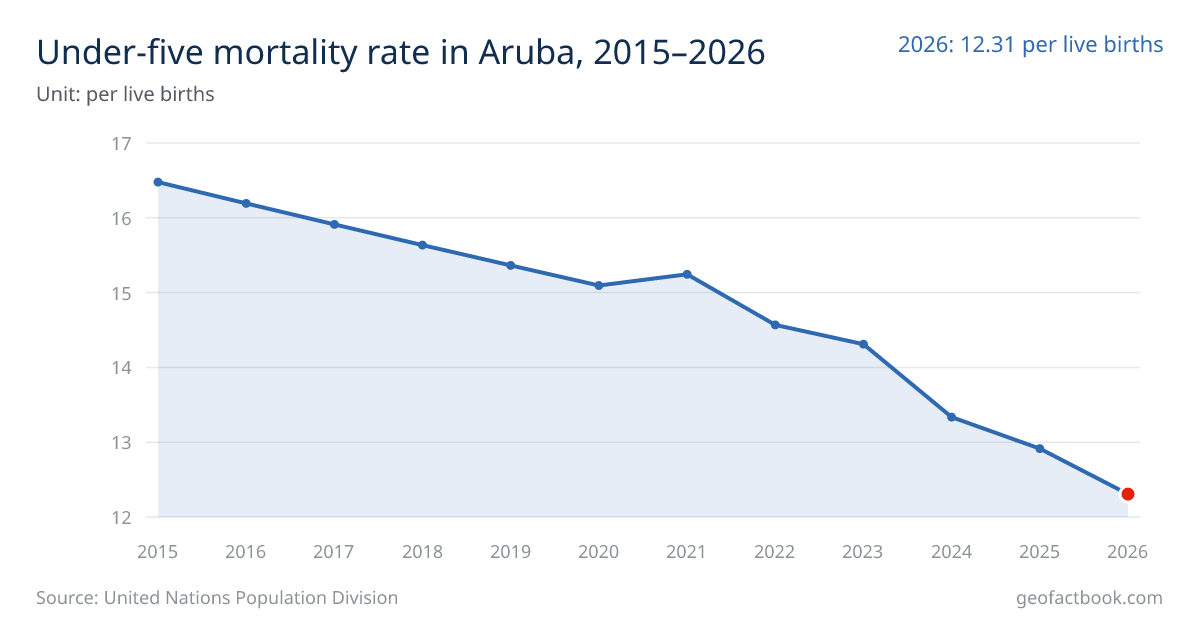
Aruba's under-five mortality rate in 2026 is 12.31 per live births (estimate), down 4.7% from 2025. It ranks #110 of 236 countries.
The under-five mortality rate measures the number of deaths per 1,000 live births for children under five. This critical statistic highlights child health and development, reflecting a country's healthcare quality and socioeconomic conditions. Understanding these rates is vital for improving global health initiatives.
Estimated value for 2026 (interpolated, no direct source).
Where Aruba ranks (2026)
#110 of 236- #108
 Mauritius12.52 per live births
- #109
 Wallis and Futuna Islands12.45 per live births
- #110
 Aruba12.31 per live births
- #111
 Barbados12.24 per live births
- #112
 Bahamas12.08 per live births
Under-five mortality rate over timeSome values are estimated based on historical trends
| Year | Value | Change | % Change | Actions |
|---|---|---|---|---|
| 2026 | 12.31 per live births | 0.61 per live births | -4.70% | |
| 2025 | 12.91 per live births | 0.42 per live births | -3.16% | |
| 2024 | 13.34 per live births | 0.98 per live births | -6.82% | |
| 2023 | 14.31 per live births | 0.26 per live births | -1.76% | |
| 2022 | 14.57 per live births | 0.68 per live births | -4.44% | |
| 2021 | 15.24 per live births | +0.15 per live births | +0.99% | |
| 2020 | 15.1 per live births | 0.27 per live births | -1.75% | |
| 2019 | 15.36 per live births | 0.27 per live births | -1.74% | |
| 2018 | 15.64 per live births | 0.28 per live births | -1.74% | |
| 2017 | 15.91 per live births | 0.28 per live births | -1.73% | |
| 2016 | 16.19 per live births | 0.29 per live births | -1.73% | |
| 2015 | 16.48 per live births | — | — |
Under-five mortality rate in Aruba, 2015–2026: chart
Cite this page
Geo Factbook. (n.d.). Aruba: Under-five mortality rate. Retrieved November 27, 2026, from https://geofactbook.com/countries/aruba/under-five-mortality-rate
The figures on this page come from United Nations Population Division. For academic work, cite the original source as well.
Frequently Asked Questions About Aruba Under-five mortality rate
What is Aruba's under-five mortality rate in 2026?▾
Aruba's under-five mortality rate is 12.31 per live births in 2026 (estimate), according to United Nations Population Division.
Is Aruba's under-five mortality rate increasing or decreasing?▾
Aruba's under-five mortality rate fell by 4.7% from 2025 (12.91 per live births) to 2026 (12.31 per live births). Over the past decade (2016–2026) it fell by 24.0%.
How does Aruba rank for under-five mortality rate?▾
In 2026, Aruba has the 110th highest under-five mortality rate out of 236 countries with data.
What was Aruba's under-five mortality rate in 2015?▾
In 2015, Aruba's under-five mortality rate was 16.48 per live births. By 2026 it fell by 25.3%.
Explore additional statistical insights
Urban Population Annual Growth Rate in Aruba
Urban population annual growth rate measures the year-over-year percentage increase in a country's urban population.
Total net-migration in Aruba
Total net-migration measures the difference between the number of immigrants and emigrants in a country, reflecting population shifts and economic opportunities. Understanding this statistic is crucial for analyzing demographic trends and policy impacts in nations worldwide.
Share of Students Studying Abroad in Aruba
Share of students studying abroad tracks the percentage of tertiary-level students enrolled outside their home country.
Education Expenditure (% of GDP) in Aruba
Education expenditure measures the percentage of GDP spent on education. Compare countries and explore interactive rankings and trends.
Physician Density in Aruba
Physician density measures healthcare access, showing the number of doctors per square kilometer. Compare countries and explore interactive maps.
Total population in Aruba
Discover the latest total population statistics for every country and region worldwide. Explore accurate, up-to-date data on global population growth, density, and demographic trends — sourced from trusted international databases like the UN and World Bank. Perfect for researchers, students, and data enthusiasts looking to understand how the world’s population is changing.